Scaling Document Intelligence in Banking

In short
Together with our client, we designed and implemented an AI-driven document processing solution to automate the ingestion, classification, and data extraction of credit application documents. The solution streamlined document handling and reduced manual effort while laying the foundation for further automation. By combining document intelligence, data engineering, and close collaboration with business stakeholders, we developed and validated the solution in a highly regulated banking environment.

“Knowing that both AI performance and
business expectations evolve over time,
we focused on building a reusable
AI backbone rather than a one-off model. “
Louise – consultant at Searching Pi
Content of the article
- The business context and challenges behind modernizing document-heavy credit operations
- The rationale for building a reusable AI backbone instead of a one-off solution
- How AI was introduced in a controlled, compliance-friendly way
- The end-to-end technical approach, from document ingestion to structured system updates
- The operational impact delivered today and the foundation laid for future automation
Details on the challenge and approach
A Belgian bank was facing increasing pressure on its credit operations. As the number of credit applications continued to grow, so did the administrative workload required to process them. Every application contained a mix of supporting documents, from payslips and identity documents to proof of residence, family composition and collateral, often in different languages, layouts and file formats.
Processing these applications relied heavily on manual work. Employees spent considerable time identifying documents, extracting key information, validating data points across sources and resolving inconsistencies before an application could proceed. While these review and validation steps are essential to ensure data quality, regulatory compliance and sound credit decisions, the repetitive nature of the work creates a growing operational bottleneck and limits the bank’s ability to scale efficiently.
Rather than replacing these critical controls, the bank needed a future-proof foundation to reduce repetitive manual effort today and scale automation over time—all while maintaining maximum control and transparency.
Our goal: Build an AI-driven system for document-heavy processes, starting with credit applications.
Scope
The project focused on building an end-to-end AI processing layer around existing credit workflows:
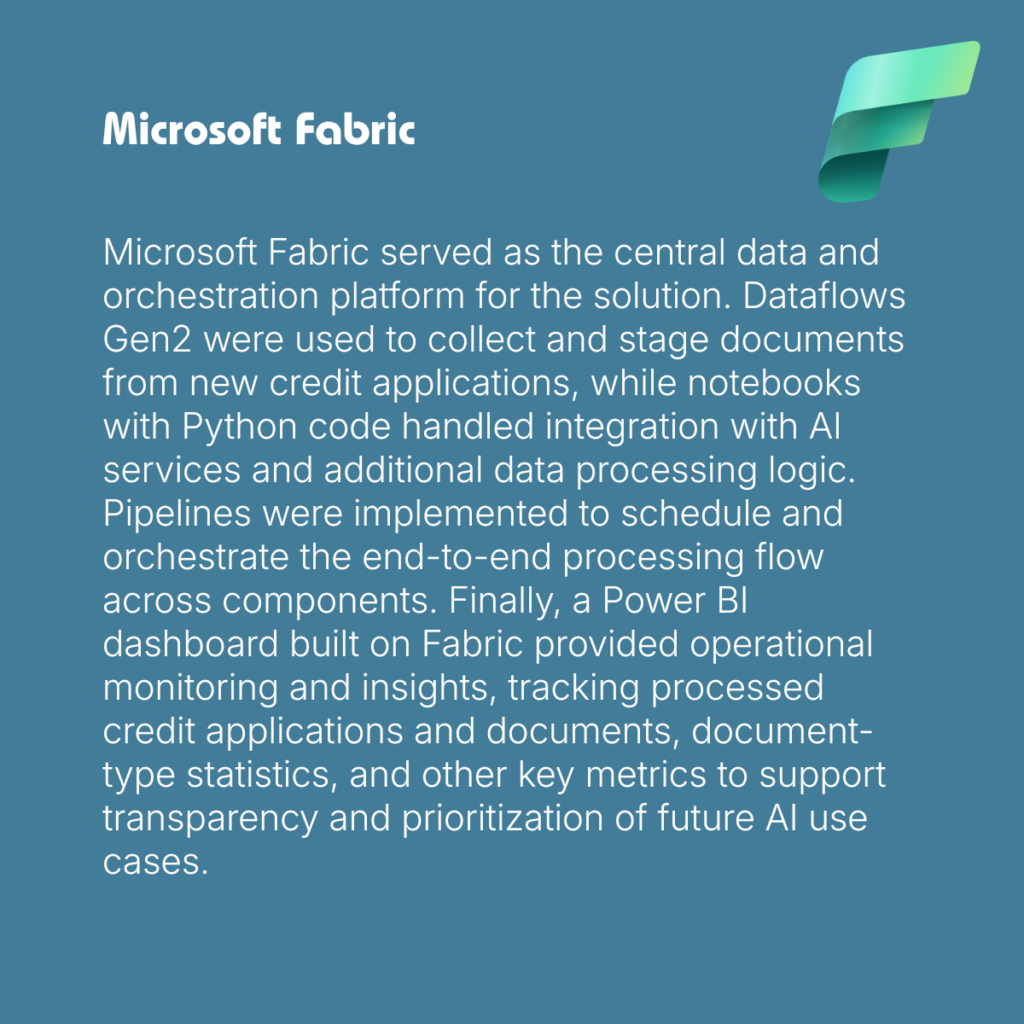
- Automated ingestion of new credit applications
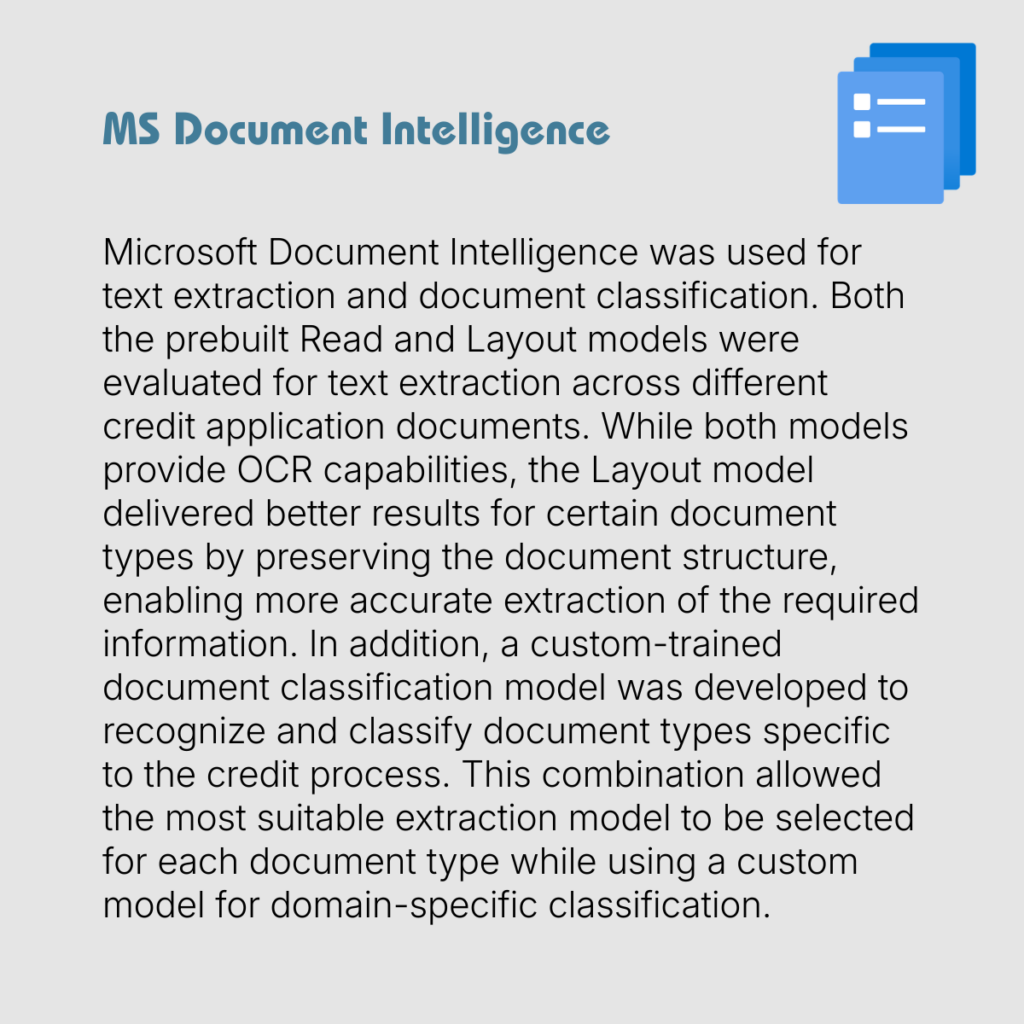
- AI-based document classification
- Structured data extraction from documents
- Comparison with manually entered data in the loan management system
- Preparation of structured updates for loan management systems
- Monitoring of processing volumes and automation outcomes
Our approach
1. Understanding the Business Process
We started working closely with business stakeholders to understand how credit application documents were processed manually in practice; including decision logic, exceptions, and regulatory constraints. Based on this analysis, we collected a representative training and test dataset from historic credit applications and established a reliable ground truth to enable objective AI model evaluation.
2. Model Evaluation and Optimization
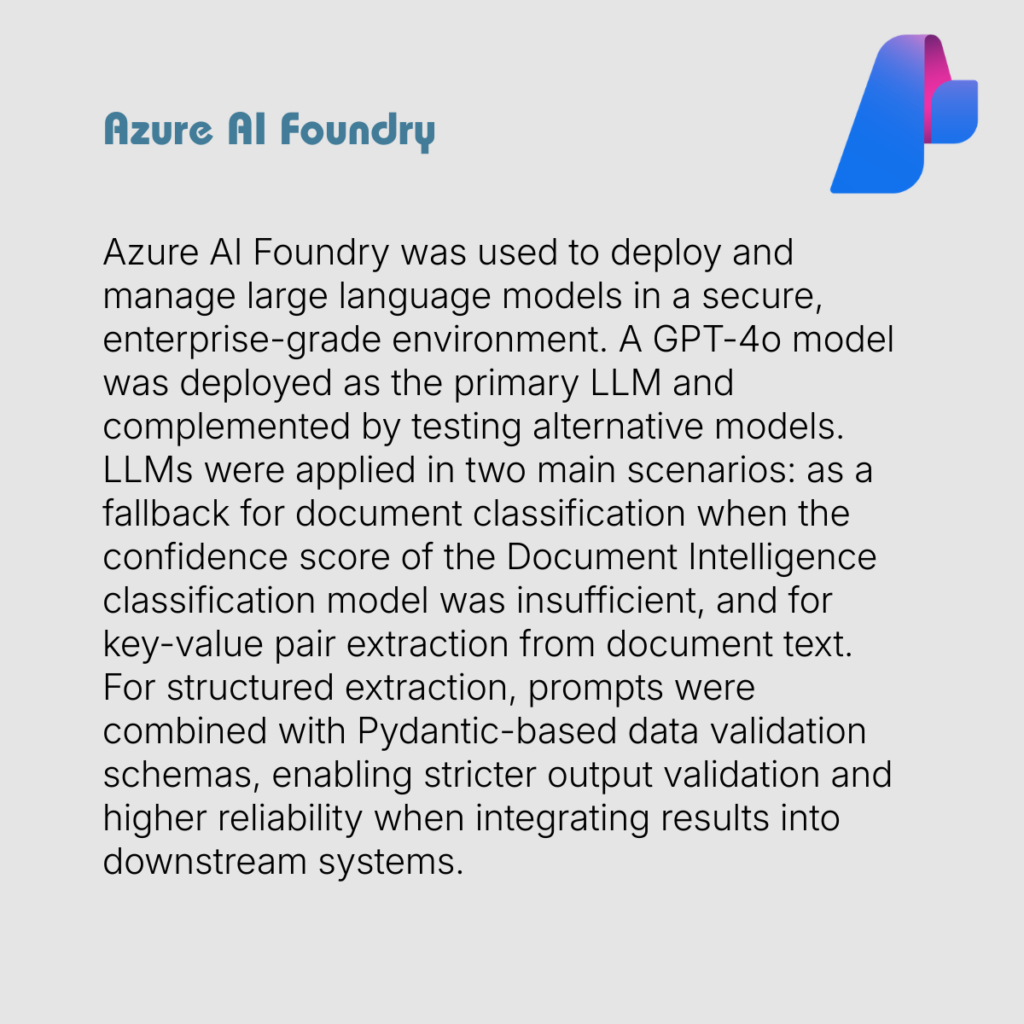
We evaluated and compared multiple AI models across key capabilities such as text extraction, document classification, and key-value pair extraction. Rather than relying on a single model, we combined different techniques and models to optimize overall accuracy and robustness. This iterative evaluation allowed us to identify the optimal model configuration for the specific document types and data fields involved.
3. End-to-End Processing Flow
Once the model setup was finalized, we implemented a complete, production-ready processing flow. Documents are ingested, data is extracted and cleaned, and results are validated against existing data in the bank’s systems. For transparency and auditability, all extracted data is consolidated into structured Excel outputs, enabling business users and auditors to easily review and trace results. The solution also generates API requests to update the bank’s loan management system, ensuring seamless integration into the existing credit workflows.
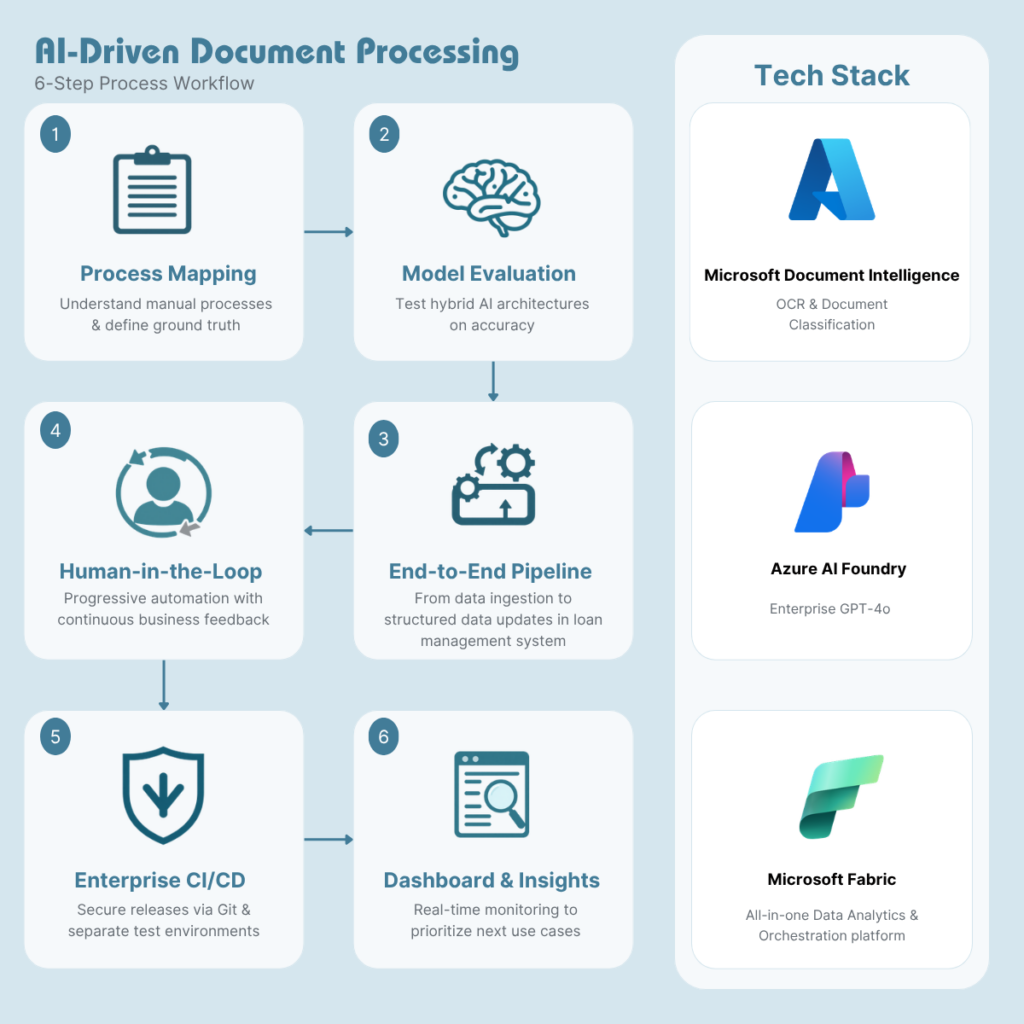
4. Progressive Automation with Business Feedback
Throughout the project, business feedback was continuously incorporated to refine model performance, validate results, and measure realized efficiency gains. The solution was designed for progressive automation: AI initially supports analysts with application pre-processing, while complete human validation remains. As confidence levels increase, selected high-quality scenarios can gradually transition toward higher degrees of automation.
5. Production-Grade Delivery and CI/CD
To ensure reliability and maintainability in a regulated environment, the project was supported by a robust CI/CD setup. Development takes place in a dedicated development environment, supported by a comprehensive testing framework with both unit and integration tests in a separate testing environment. Only validated changes are promoted to production. The entire codebase is managed in Git, enabling seamless team collaboration, traceability, and controlled releases.
6. Monitoring, Insights, and Prioritization
Finally, a dedicated monitoring dashboard was developed to track operational metrics such as the number of processed credit applications, document volumes, and the average distribution of document types within a credit dossier. These insights provide transparency into the AI processing behavior and serve as a data-driven foundation for prioritizing future AI use cases and automation initiatives.
The results
Value delivered today:
- AI-assisted document processing
- Transparency into automation coverage
- Reduced repetitive manual work
Strategic value for tomorrow:
- Scalable AI foundation